class: center, middle, inverse background-image: url("images/SoEWebinar2020_TitleSlide.svg") --- class: center, middle # Land Acknowledgment "I (we) wish to acknowledge this land on which the University of Toronto operates. For thousands of years it has been the traditional land of the Huron-Wendat, the Seneca, and most recently, the Mississaugas of the Credit River. Today, this meeting place is still the home to many Indigenous people from across Turtle Island and we are grateful to have the opportunity to work on this land." University of Toronto -- Centre for Indigenous Studies: https://indigenousstudies.utoronto.ca/ --- class: inverse, middle ## From Good Intentions to Actions * Are those whose land we are on represented at U of T? * Do they hold positions of power? * Taking actions to change who is represented in science, and whose knowledge is valued. --- class: middle # Introduction --- class: inverse, center # A statistician's journey here I love doing math and I love learning about the ocean, particularly sharks. 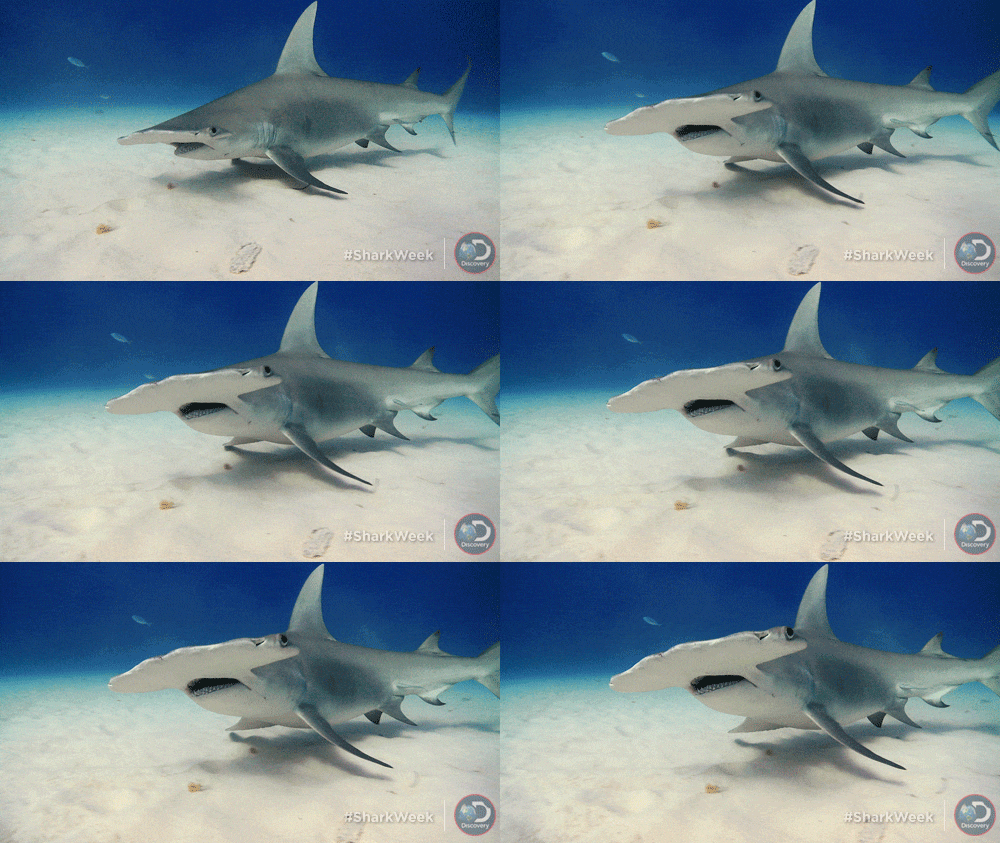 Why not become a statistician and help with ocean (shark) conservation? --- ### What I thought I'd be doing: - Apply mathematical models to perfectly collected data - Come up with novel algorithms/statistical models -- ### What I actually do: - Spend 1-2 months asking questions about the science - Think about biases in data/science experiment - Build (novel) models that go with the biology -- COLLABORATE! -- ### What I want to talk about here: _Rooting an analysis in domain expertise._ _Aligning statistical methods with the scientific question._ --- class: inverse, middle # An Environmental Data Analysis --- ## A Data Analysis Flowchart 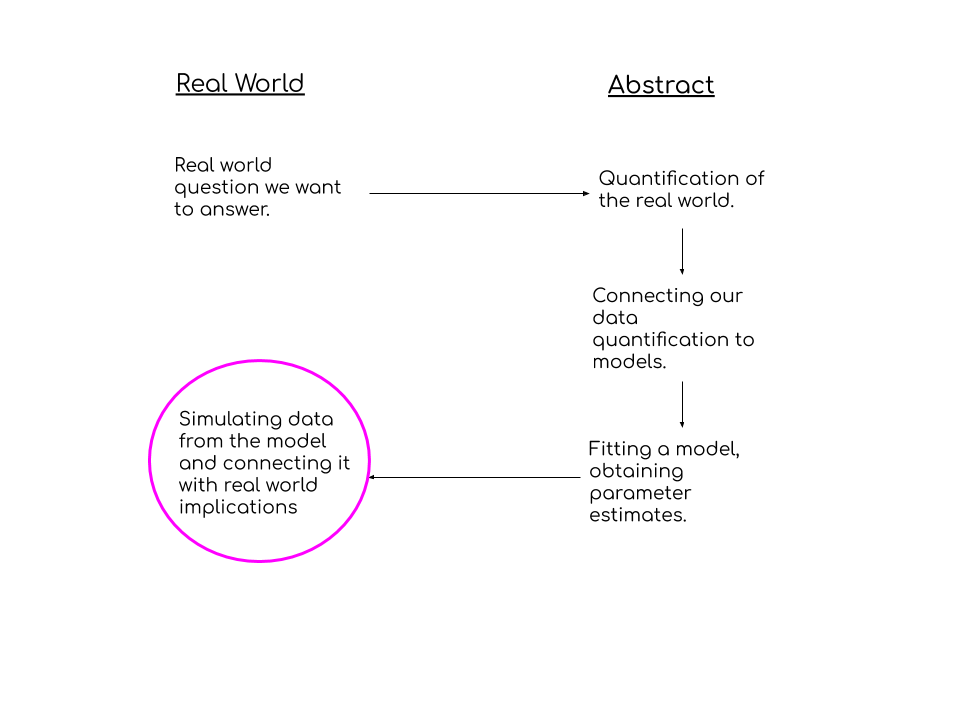 --- ## A Key First Step 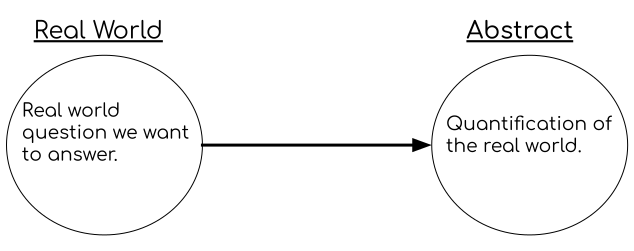 For example: * How will migratory sharks be affected by ocean acidification? * How does sonar affect the behavior of marine mammals? --- ### Shark Behavior: Research Question and Quantification How do white sharks behave around seal colonies? <img src="https://media.giphy.com/media/11xNRqjzsILefu/giphy.gif" width="150"/> 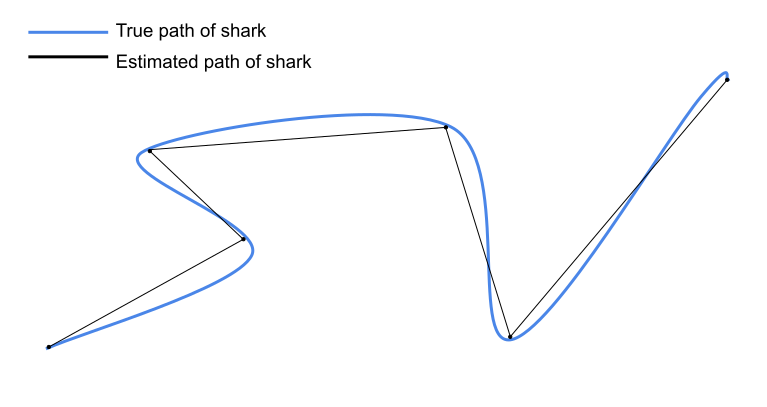 --- class: inverse ## Biases and Limitations .pull-left[ ### What We Can Do - What data can be collected? - What resources are at our disposal? ] .pull-right[ ### What We Can Not Do Without infinite resources: - What data can we not collect? - When can we not collect data? ] ### For the sharks: - Only one shark can be followed at a time - The weather impacts when they can be followed. - Movement simplified to horizontal tracks. --- ## Abstraction and Modeling  --- class: inverse # Models ### How does the specification of our model connect with the collected data? -- - How does specification of a mathematical/statistical structure align with how the data was collected. - Collected over time, over space, across multiple individuals? - Can the model generate data similar to our data? -- ### How does it connect with the scientific question? Keep the focus on the scientific question... -- ... NOT on 'significance'. --- class: inverse, center, middle # Key Point 1: Rooting Our Analysis in Domain Expertise --- class: inverse, center, middle # Key Point 2: How Does the Statistical Method Align with Your Scientific Question? --- ## Fitting a Model -- Parameter Estimation  __Statistical funhouse.__ --- ### Example: Simple Linear Regression $$ Y = \beta_0 + \beta_1 X + \epsilon $$ $$ \epsilon \sim N(0, \sigma^2) $$ $$ Y|X \sim N(\beta_0 + \beta_1 X, \sigma^2) $$ -- <img src="index_files/figure-html/plot-1.png" style="display: block; margin: auto;" /> --- class: middle, inverse ### What happens after fitting a statistical model? _Common Approach:_ Is `\(\beta_1 \neq 0\)`? --- class: inverse ## The Allure of Significance -- _Interpretation of parameter estimates_: -- - Remember these are still abstract concepts - Usually, there's some mathematical definition (for a 1 unit increase in x, we expect such change in y) -- _Significance_ : - Statistical significance `\(\neq\)` scientifically important - How does significance connect with the scientific question? - Aside from significance, what other measures connect with the scientific question? -- _Keeping in mind our two key concepts as mentioned before:_ 1. Rooting Our Analysis in Domain Expertise 2. How Does the Statistical Method Align with Your Scientific Question? --- ### From Abstraction Back To Reality  --- ### Simulating Data from the Model <!-- --> --- ### Connecting results to actions __Based on the simulated data from the fitted model:__ - How do we interpret the results? - What does significance mean in practice? __How does the data analysis fit a__: - Conservation narrative - Environmental narrative - Social/environmental justice narrative - Policy narrative -- ### How do we use these results to make the world a better place? --- class: inverse, middle, center # A bit of my work --- ### Example of Some of My Projects: .pull-left[ Statistical modeling of animal movement: - Furthering our understanding of the underlying animal biology - Conservation efforts ] -- .pull-right[ Forecasting short-term wind speeds: - Data collected from a wind farm - Connected with performance of wind turbines - Management of wind farm + ecological/environmental impact ] -- __Feedback loop of interdisciplinary work:__ .center[ <img src="images/feedbackloop.svg" width="600"/> ] --- class: center, middle, inverse # The Ethics of An Environmental Data Analysis --- ## Science Does Not Exist in a Bubble Without context and understanding, *data-driven* and *automatic methods* can and DO have severe repecursions. .center[ <img src="images/algo_oppression.jpg" width="200"/> <img src="images/datafeminism.jpg" width="200"/> ] --- # A Complete Environmental Data Analysis .pull-left[ ### Data Analysis Flowchart  ] -- .pull-right[ - Rooting our analysis in domain expertise. - Understanding scientific context - Interpreting results with the biases and limitations in mind. - Who is afforded the opportunity to do ask the research questions and do the analysis? How does this affect the research conducted? - Who does the science, who is affected by the outcome? ] --- class: center, middle, inverse #Thank you for joining today!  # Questions? Contact: vianey.leosbarajas@utoronto.ca